Wednesday, April 10, 2013

Semana Santa

Holy week, or Semana Santa, is a big deal in Spain. Although not a lot of people go to mass every week, it seems like everyone goes to at least one procession during Semana Santa. There were plenty of processions to choose from in Salamanca. Starting the Sunday before Easter, there was at least one procession every day and multiple processions a day towards the end of the week. They started from different churches/cathedrals and took place all times of the day and night. Families lined up for the processions ahead of time like we would for a parade in the US (unfortunately none of the priests threw out candy).

Processions consisted of priests, fancy costumes (yes, some processions had the [in]famous KKK-looking gowns), bands, and the highlight of processions: one or more imágenes. An imagen is giant float carried by a group of people that has a depiction on it such as Jesus on the cross or the Virgin Mary. Some of are hundreds of years old and weigh up to 1000 kilos (~2000 lbs).

Here's some pictures from a procession Sunday afternoon:


the imagen
The people carrying it are hidden by the clothe.


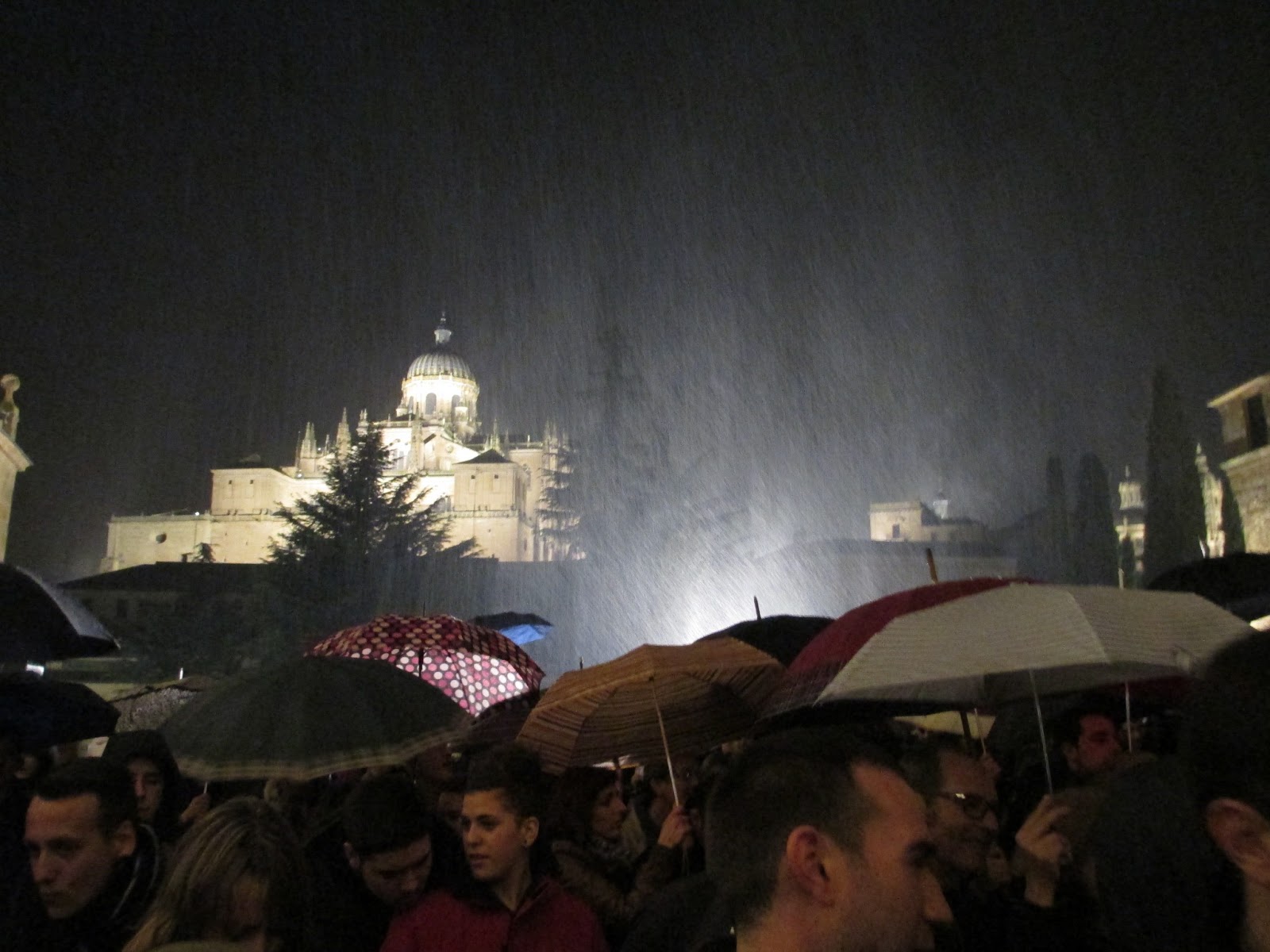
It was raining Thursday night, so they canceled the procession that was supposed to cross the old Roman bridge. They still brought the imágenes right outside the church for people to see, though.


torrija, a traditional dish served during Semana Santa (It's like french toast).

I was also talked into staying up for the 5:30 am procession Friday morning. It was going to be a huge procession with 4 imágenes that left from San Esteban, one of the big cathedrals in Salamanca. While we were waiting, I had some torrija, a french-toast-like dish traditionally served during Semana Santa. It was raining off & on, so they just carried the imágenes to the door of San Esteban for people to admire.


Monday, March 11, 2013

Portugal

I just got back from a weekend in Portugal! It was the last of our ISA excursions, and it seems like they were saving the best trip for last. The amazing weather in Lisbon certainly didn't hurt. It was in the 60's with a refreshing ocean breeze, and the rain held off until Sunday afternoon when we were on our way back home to Salamanca.

We left Salamanca early Friday morning (well 8:30am seems kind of early to me, and really early for our host mom, who got up to make sure Jack & I were up). It was a 5 or 6 hour bus ride to Lisboa, the capital of Portugal. It didn't seem like that long of a trip because: 1) The bus was big enough that most of us had two seats to ourselves. 2) We stopped twice for lunch/snack breaks. 3) Portugal is an hour behind us, so we gained an extra hour.


ISA always picks really nice hotels to stay in for the excursions, and Lisboa was no exception. We were in the Hotel Altis, which seemed like a 5-star hotel. No one on the ISA staff speaks Portuguese,  which is probably one of the reasons they chose Hotel Altis- the hotel staff spoke Portuguese and English. There were a lot more people in Lisbon that spoke English than in Salamanca. It's odd that more people don't speak Spanish, since it is so similar to Portuguese. Supposedly there is still a lot of animosity between Spain and Portugal left over from when Portugal fought for their independence from Spain. I could kind of understand people when they were speaking in Portuguese and native Portuguese-speakers can understand Spanish without too much trouble, but quite a few people in Spain recommended speaking in English because Portuguese people sometimes get offended when you try speaking Spanish to them.

Friday afternoon, we checked out the Plaza de Comercio --Well I think it's technically the Plaça do Comércio in Portuguese. To me, Portuguese seemed like a made-up language where someone just decided to take the Spanish word and move the accent mark or changed the spelling so it was written differently but pronounced the same way.-- Anyways, the Plaza de Comercio is right next to the Tagus River and has an amazing view looking out at the bridge and the Cristo-Rei, a statue modeled after the famous statue of Christ in Rio de Janeiro. The plaza (along with most of Lisboa) was completely destroyed by an earthquake in 1755. The earthquake was so powerful that it did a lot of damage in Spain, too. In fact, it destroyed part of the Nueva/Vieja Catedral in Salamanca! 

looking out at the river from the Plaza de Comercio

Afterwards we visited the Castillo de San Jorge, an ancient castle originally built by the Moors in the 12th century. When Portugal's first king conquered Lisbon, it was converted into a royal palace. After Portugal became part of the Spanish empire, it was used as a military installation. It's on the top of a giant hill, so it is very strategically located. The walls and towers also provide an amazing view of the city.


This belongs on an ISU study abroad brochure!
(Caitrin goes to ISU, too.)

Friday night I went out to eat with a big group of ISA students. I tried some fried bacalao (codfish), which is one of the foods Lisbon is known for. I also had some vino verde (green wine), which is typical of Portugal. Contrary to the name, it wasn't actually green, and it was pretty good.

Saturday morning we toured a few different places as a big ISA group. We started off by visiting the Monasterio de los Jerónimos, a giant complex shaped like a cross. Monks no longer use the monastery, it's just a museum. After visiting the cathedral connected to the monastery, we stopped at a bakery famous for it's pastel de nata (cream pastries). They didn't look very good, so I only got one. It turned out they were delicious! I almost got back in line for another one.

Monasterio de los Jerónimos
royalty got elephants to carry them

pastel de nata

Later we stopped at the Torre de Belém, a giant tower that was once used to defend the river from attacks. There used to be another tower on the other side of the river and together they would be able to keep enemy ships from traveling up the river and attacking Portugal. The tower had 1 tiny spiral staircase with no handrails, so it was quite the challenge going up and down against a throng of other tourists.

Torre de Belém
view from the top
Andy with some bacalao and my "hamburger"
that didn't come with a bun.

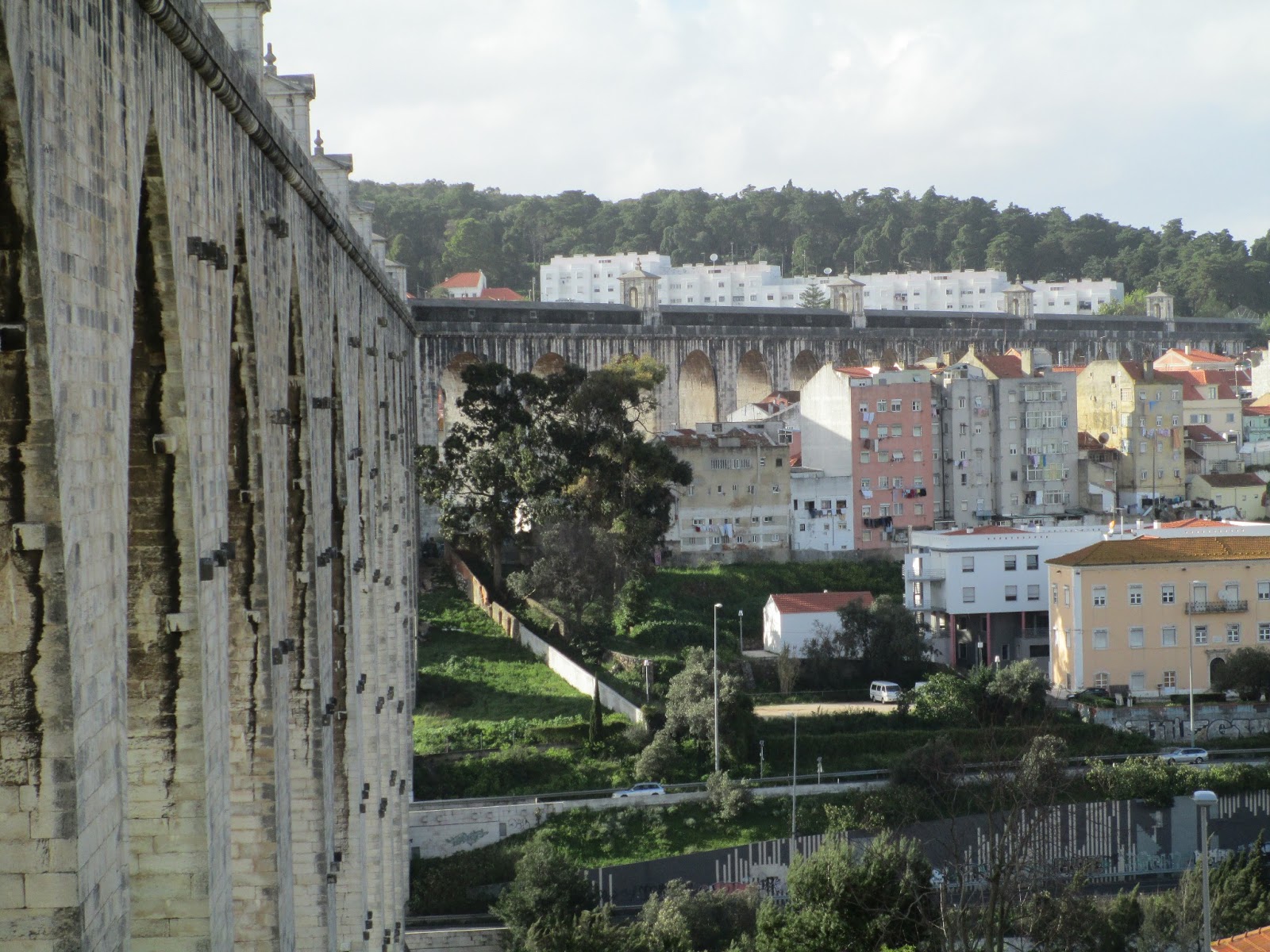
Saturday afternoon I explored Lisbon with Andy (another ISA student). We ended up finding this awesome place to eat lunch downtown where we got a ton of food for less than 6 euros each- I got a delicious hamburger and Andy tried the bacalao. After lunch we walked quite a ways to check out the aqueduct. We had driven by it on the bus and I figured it would be interesting to see closer up and get a few pictures. For such a giant structure, it was surprisingly difficult to find, probably because like Spain, there aren't any roads that just go north-south or east-west.


When we found the aqueduct, I noticed what appeared to be a walkway along it. After exploring a little bit, we found a tiny park that was also the entrance to the aquaduct walkway. It was an incredible view and we could even see what the inside of the aquaduct looked like! Afterwards, we celebrated finding the aqueduct by stopping at a bakery and getting some more pasteles de nata.

the aqueduct
The walkway along the aqueduct
The inside of the aqueduct

more pasteles de nata


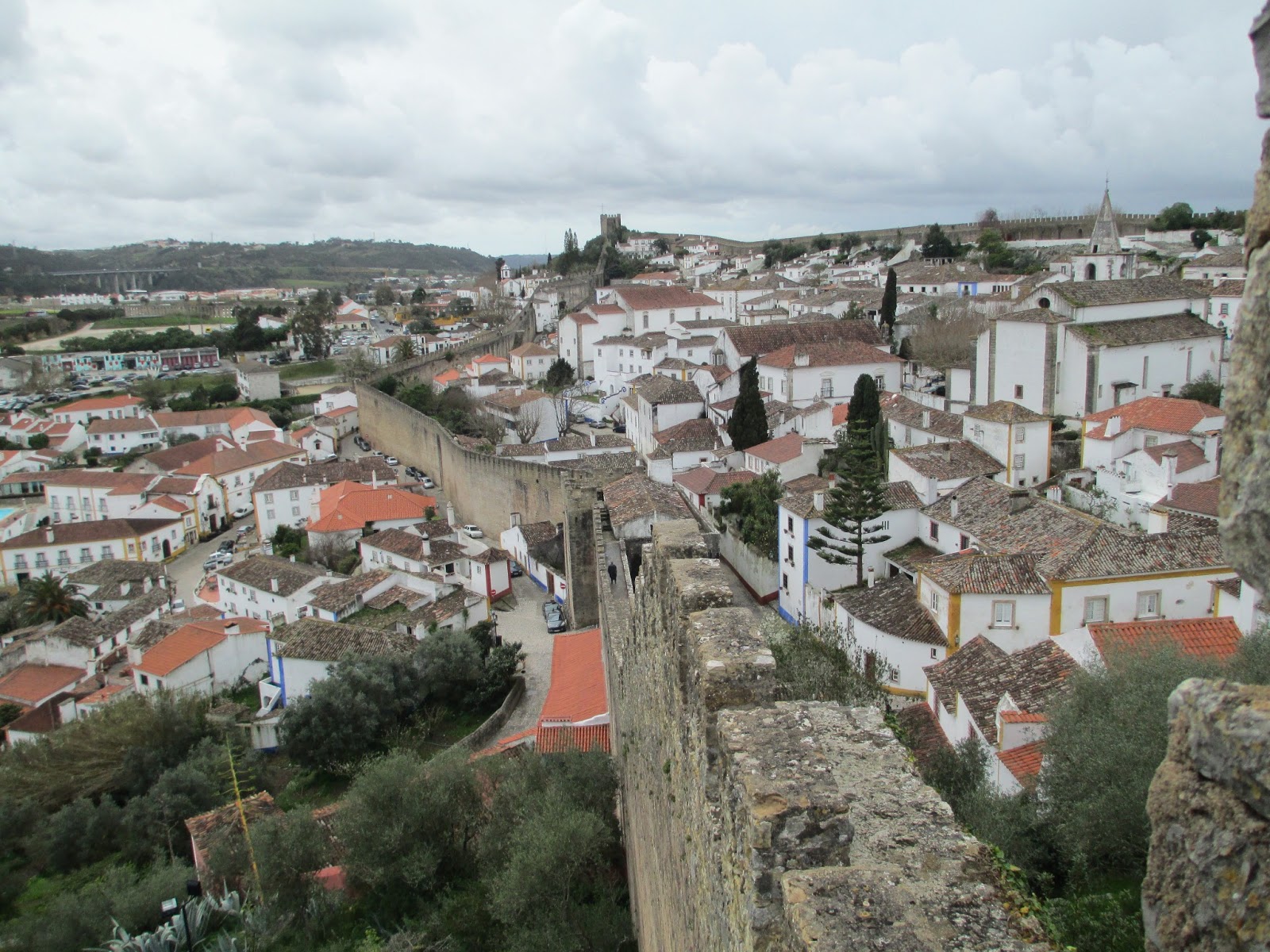
Sunday morning we left for Salamanca. We took the scenic route back, stopping along the way at two small cities in Portugal. Óbidos was our first stop. It was fairly small, but historians can tell that it had once been a very important city because it has an aqueduct. There was also a giant wall surrounding the city. I spent the entire time there walking along the wall up to what used to be the castle (now it's a hotel). One side of the path along the wall didn't have anything to keep you from falling off the edge, but it was a wide enough path that I didn't have to worry (too much) about falling off.


Here's the start of the wall
And this is looking back from the tower in the top right
of the pic above.

Our second stop was Batalha, Portugal to visit the Monasterio de Batalha. It was built by the King Juan I of Portugal to commemorate Portugal's victory over Spain, winning their independence. Portugal's Tomb of the Unknown Soldier, guarded by soldiers 24/7, is located inside the monastery.

Monasterio de Batalha
Tomb of the Unknown Soldier
no roof- they never finished it because they
ran out of money first.


I've never been to San Francisco, but Lisbon reminds me of what San Francisco is like in movies. It's a city on the ocean with huge hills, lots of trolley cars, and a giant bridge. It also happens to be the second oldest city in Europe (Athens, Greece is first). It was a blast spending the weekend, but I wish I would have taught myself a little more Portuguese before going --especially the phrase "Do you speak English or Spanish?"... not that they didn't usually understand if I asked in Spanish or English, but I could never decide what language to try. My Portuguese vocabulary was pretty limited... I got a lot of practice saying "Bom dia!" and "Obrigado!"

San Francisco?
Whoops- I have been accidentally alternating between using Lisbon and Lisboa. They're the same city... Lisboa is how it is spelled in Spanish and Portuguese. For some reason, someone decided to change it to Lisbon in English.

Monday, March 4, 2013

¡Fútbol y Segovia!

As usual, I have neglected my blogging duties. (I apologize to everyone relying on reading these posts to procrastinate on their homework). In an attempt to catch up, I'm just going to combine everything that has happened since my last post into one mega-post. And by "everything" I mean briefly describe the highlights of what's happened.

I started classes 3 weeks ago (Feb. 11).  Later on this semester I'll probably dedicate a longer post to describing my classes, so for now I'll just lay out the basics:

  • I'm taking normal classes with local Spanish students at the University of Salamanca, the oldest university in Spain! 
  • I have class Monday - Thursday, which is typical of college students here (I didn't have to try to get my schedule like that, there just aren't really any classes offered on Fridays).
  • I'm taking 4 classes: Programación II (Programming), Historia de España Actual (Recent History of Spain), Cultura Hispanoárabe (Hispano-Arabic Culture) y Metodología de la Enseñanza Español (Teaching Spanish as a Second Language).


Partido de fútbol de Real Madrid

The Sunday before my second week of class (Feb 17), ISA organized a short trip to Madrid to watch Real Madrid take on Rayo Vallecano in soccer. We didn't leave for Madrid until 4pm. It's crazy that I can just hop on a bus and travel across the country. Everything seems a lot closer than the US, since Spain is so small. It was only about a 2 hour bus-ride from Salamanca to the stadium. We got there about 2 hours before the match started, so we had time to explore the area around the stadium a little before the game. We ended up stopping at a bar to soak in the ambiance (along with the heat) and grab some tapas (snacks) before the game.

After checking out the street vendors and resisting the urge to buy a vuvuzela, we found our seats in the upper deck. Our section was about as high up as you could get, but it wasn't a bad thing. We had a great view of the entire field, were right next to the outdoor heaters the stadium had, and were under the roof. It was raining and cold, but it was dry and warm-ish in our seats! 

I thought it was a great game to watch. Real Madrid dominated for the first 10 minutes, scoring 2 goals. Just as it was looking like it would be a complete blowout, one of Read Madrid's players got two yellow cards within a minute, resulting in a red card for him... which meant Read Madrid had to play a man down for the rest of the game. That made the remaining 80 minutes pretty competitive. The final score ended up being 2-0, but it was entertaining.

After the match, we wandered around for about half an hour looking for the bus. It turned out we had been walking down the wrong street, and eventually found the bus driver and headed back to Salamanca. I didn't make it back to my house until around 2:30am and had to get up for 9am recitation the next morning, but it was definitely worth it. ¡Gracias a dios por las siestas!


Side Note: I have never seen anyone wear so much hair-gel while playing a professional sport as Ronaldo. I suppose he thinks it will help his case if he looks good while complaining to the referee about a call or faking an injury.

And yep, as you can tell, I'm a preeeeetty big Ronaldo fan.


Segovia

Saturday, Feb. 25th I went with ISA on a short day trip to Segovia, a small city about 2 hours east of Salamanca. There were a lot of interesting sites to see in Segovia, but I recommend picking a warm day to visit... it was below freezing out, which made it really difficult to concentrate on the tour guide while standing outside the Cathedral as she gave a brief synopsis of the history of the world (or maybe it just felt like that).

La catedral

The seats had a ledge so you could rest while standing
during the really long masses!

We started off the day with a presentation/demonstration from a pottery artist. He showed us how simple bowls and cups were made by hand, and then made fancier bowls using a pottery wheel. Pottery artists used to be one of the most important professions because everyone needed them to get cups, bowls, plates, etc. Now it's just a hobby for people.


Next we headed to the Alcanzar, a royal palace that has been around for almost 900 years. A fire in 1862 completely destroyed it, though. It was rebuilt and is now used as a museum. It was interesting to see the architecture inside, but slightly less impressive once I found out about the fire and that pretty much everything in there was just replica of the original.

I was amused that there is now a fire extinguisher in
the room where the fire started that destroyed Alcanzar.
A room filled with models of old kings of Spain


We stopped by the cathedral after the Alcanzar. It looked very familiar because it was designed by the same architect that built the Nueva Catedral in Salamanca. Then we ended the tour at Segovia's famous Aqueduct. The aqueduct was built around the end of the first century by the Romans using granite blocks without any mortar! (I noticed no one was standing under it...) It's pretty impressive that they were able to design and build that massive of structure almost 2000 years ago!


Friday, February 22, 2013

Sights and Smells of Sevilla


I'm a few weeks behind on my blog... I've started operating on Spanish time, though, so I'm not too worried about it. ;) Two weekends ago (Feb. 8) we had an ISA (my study abroad group) excursion to Sevilla. I had to get up at the crack of dawn, AKA 7:30, for the 4 hour bus ride south. 

We arrived in the late afternoon and took a short walking tour of the city. Historically, Sevilla is considered one of the 3 most important Spanish cities (along with Madrid & Barcelona). How important, you ask? Well, when Christopher Columbus returned after discovering the new world, he came to Sevilla. The architecture in Sevilla is very different than most cities in Spain. There is a lot of Arabic influence, which is unusual because typically the Christians destroyed the Arabic buildings when they arrived. 

Torre de Oro

Besides the unique architecture, Sevilla is famous for its Flamenco dancing. After the tour we went to a Flamenco museum. Not just any Flamenco museum, but the one started by Cristina Royos, who is considered to be the mother of Flamenco dancing (at least according to the museum that she funded). I'm sure you're all huge Flamenco fans, but for those who don't know, Flamenco is a type of dance popular in southern Spain that has evolved over the years to incorporate styles from Romani, Spanish, and various other cultures.

After going through the museum, we got to see a live Flamenco performance. I'm not usually a big fan of watching people dance, but it was pretty incredible! The music was what really made the show- they had a guitar player and a singer. It's hard to describe, but there was a lot of stomping, clapping, and passionate singing. 

After the Flamenco museum, we had the rest of night free. I convinced a few friends not to eat at KFC or Burger King and come with me to find someplace to eat by the river instead. We checked out someplace recommended by ISA, but it was super pricey so we tried to find a dive instead. We picked a cafetería at random and had some pretty delicious fish and fries.

Saturday we checked out some more Arabic architecture and took a tour of the cathedral. We also made our way to the Plaza de España, a giant plaza with a little pond in the center of it. I think it's Sevilla's version of a Plaza Mayor. Later I went on a tour of the bullfighting ring (bullfighting season doesn't start until later this summer). It was interesting learning about the history of bullfighting. I don't know if I want to go see a bullfight or not, since there's a lot of blood and 3 bulls are killed. Technically, it's possible for the bull to get pardoned if both the matador and the bull fight flawlessly. I asked the guide how often it happened, and she said twice ever in Sevilla.

view from the Cathedral's tower

Bullfighting ring: it costs more to sit in the shade!

Fun Fact: There were large piles of trash all over the city while we were there because the garbage workers had been on strike for 2 weeks. The city wanted to cut the number of workers & increase the workload for the remaining workers without any pay raises. I can see why they were upset, but I don't know how much bargaining power they have with unemployment above 20%. The strike ended just before we got there, so they were working around the clock to pick up the city.


We headed back on Sunday, but stopped in Mérida on the way back. Mérida is a small town with Roman ruins; there was an amphitheater where gladiators would battle and classical theatre where they would have plays. Unfortunately my camera was dead, so I don't have any cool pictures to post. Good thing I used my camera to get this picture of the trash! ;)

Thursday, February 7, 2013

Barcelona- My camera's zoom is broken so all my shots are close-ups now

My three-week intensive Spanish class ended January 25th and the second semester for the university doesn't start until next Monday, so I've been on vacation for the past two weeks (I'm sure you're thinking: "Hey, isn't his entire semester one big vacation?!"). Since we didn't have classes, a group of ISA students decided it would be a good time to travel. RyanAir had some cheap flights to Barcelona, so 6 of us decided to go to Barcelona for an extended weekend!

We left last Thursday (Jan 31st) at 8:30am. Salamanca doesn't have an airport that RyanAir flies out of, so we had a two-hour bus ride to Valladolid, a city east of Salamanca. After spending the afternoon chilling at the tiny airport near Valladolid, we had a short flight (I was sleeping, so I have know idea how long... 2 hours maybe?) to Barcelona.

We took a 6-person taxi from the airport to our hostel. The taxi driver may or may not have ripped us off. We were told by ISA that all taxis charged the same, no matter how many people you had, but the driver convinced us that it was like that for normal taxis but the larger taxis charged 10 Euros per person to get to the center of the city. We didn't really have any idea, so we just went with it. 

We stayed at the Mediterranean Hostel, which we picked because it was cheap and got good reviews. It turned out to be in a great location- we could walk to the Sagrada Familia, the beach, and Las Ramblas. Our room also happened to have a sweet glassed-in balcony. 

Thursday night we went for a walk to explore Barcelona a little bit. We happened to walk past the Casa Batlló (the house with a roof that looks like a dragon)! Barcelona is full of crazy buildings and parks designed by Gaudí. I also stopped at an ATM right outside a bank to get some money. Most people think of Barcelona as being full of pickpockets, but I'll remember it as a city with nice, trustworthy bankers... I tried three times to get money out, but it didn't work. As I was starting to try a fourth time, three guys came out of the bank and stopped in the doorway, giving me a funny look. I was probably giving them a pretty funny look back, since I automatically assume everyone is a potential thief whenever I am taking any money out of an ATM. It turns out they were stopping in the doorway to turn out the lights and lock the door (a lot of businesses are open pretty late in Spain). At this point, I figured they were either bankers or had just finished robbing the bank. They looked pretty trustworthy, so I asked why it wasn't working in (very) broken Spanish... I was kind of flustered. They told me to try it again, and it worked perfectly, so I looked even more foolish. Oh well, at least I got some money...

Friday we checked out the Sagrada Familia, a giant Basilica designed by Gaudí. It's actually still under construction. If you ask me, Gaudí gets too much credit for these buildings, considering he comes up with designs so complicated that they're still working on them! La Sagrada Familia is pretty impressive, though. The facades on the sides of basilica are huge and tell complete stories from the Bible. For example, one facade is the birth of Christ. 


The inside of the basilica was beautiful. It's filled with giant pillars that seem to go up forever. It felt more like a historical site than a church, compared to the other basilicas I've seen. There was a lot of information on how it was built and even a museum below the basilica. I geeked out over all of the information they had. We also got to go up into the towers, which provided an up-close view of the architecture and an amazing view of the city. The Sagrada Familia was by far my favorite site we visited in Barcelona!


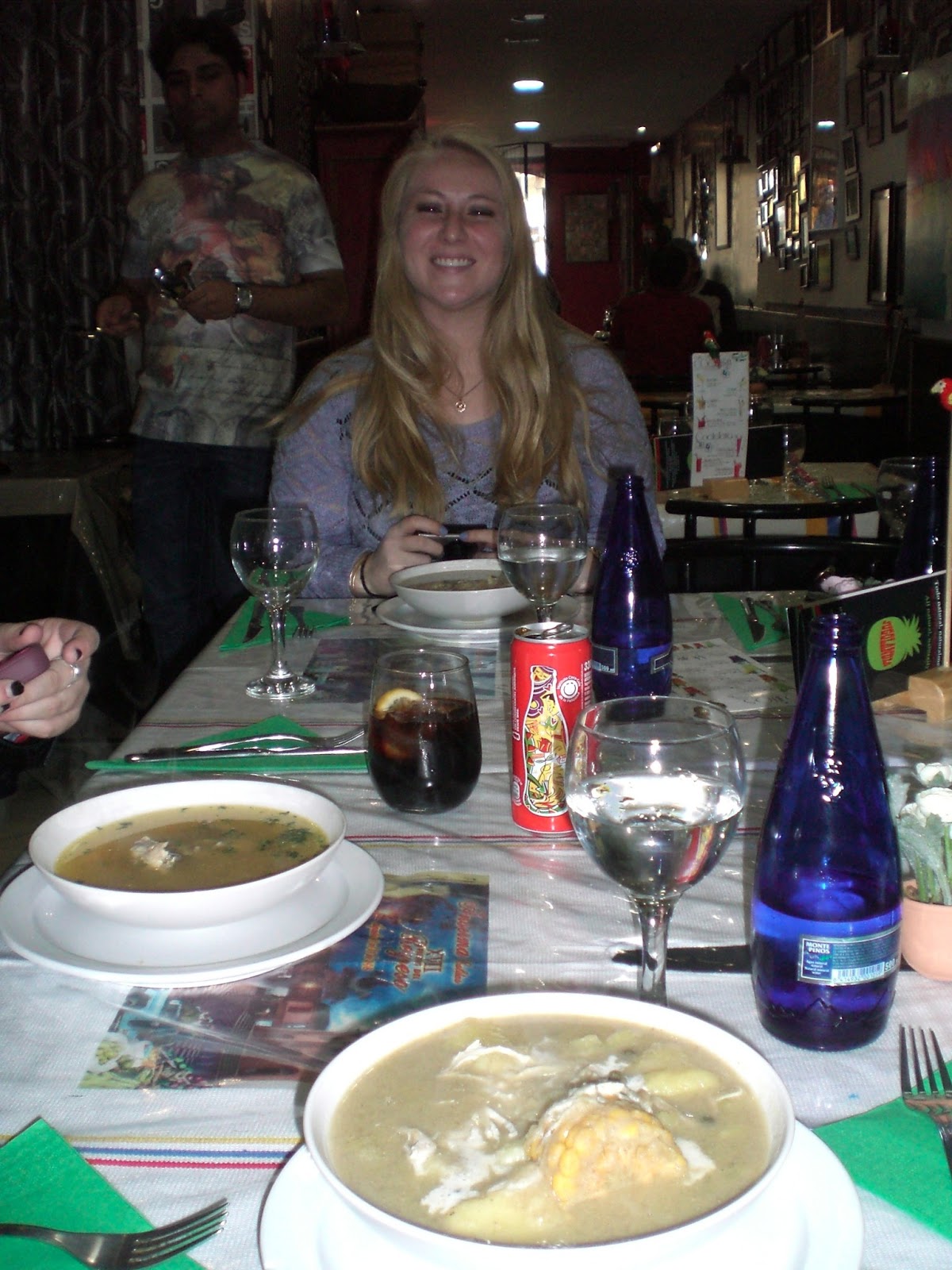
On the way back to the hostel, we stopped for lunch at a Colombian restaurant for lunch. Angie (another ISA student) grew up in Colombia, so when she saw the Colombian flag outside of the restaurant, she convinced us to stop and see how good of food they have in Colombia. She was right! I had Ajiaco, a thick traditional soup that had potatoes, chicken, and corn-on-the-cob in it. And that was just the first course! The meal also came with rice, beans, meat, a drink, and dessert- all for under 10 Euros!


We spent most of Saturday at Park Guill, a famous park designed by.... (you guessed it:) Gaudí. The park is north of the beach, and there's an amazing view of the ocean. It's also at the top of a giant hill, so you have to walk up a giant incline and a lot of stairs to get to it. Luckily they have outdoor escalators for the tourists! The park is filled with Gaudí's work, including the famous lizard that is one of the unofficial symbols of Barcelona.


Sunday we walked to the beach. It was chilly (I was wearing a jacket), but there were quite a few people hanging out at the beach. It's still way too early to swim, though. I'm sure it was deserted compared to how busy it gets in the summer. We also walked around the Olympic Park and got to see the Arc de Triomf. Apparently Paris isn't the only city that has a Victory Archway.


Monday we headed back to Salamanca. Barcelona was an awesome place to visit, but I'm glad to be living in Salamanca. Barcelona felt "more Spanish" than Madrid, though. Madrid just kind of felt like a big city. Barcelona has so many unique cultural things that are only found in Spain. It also felt more "touristy" than Madrid. Almost everyplace we went, people could speak English. All of the signs were in Catalan, though. (Catalan is actually their primary language in north-eastern Spain, although pretty much everyone speaks Spanish as well). Catalan looks like a made-up language that is a cross between Spanish and French. I never thought seeing signs in Spanish would be comforting, but it was nice to come back to Salamanca, where I can understand the signs (at least a little bit better than the ones in Catalan).